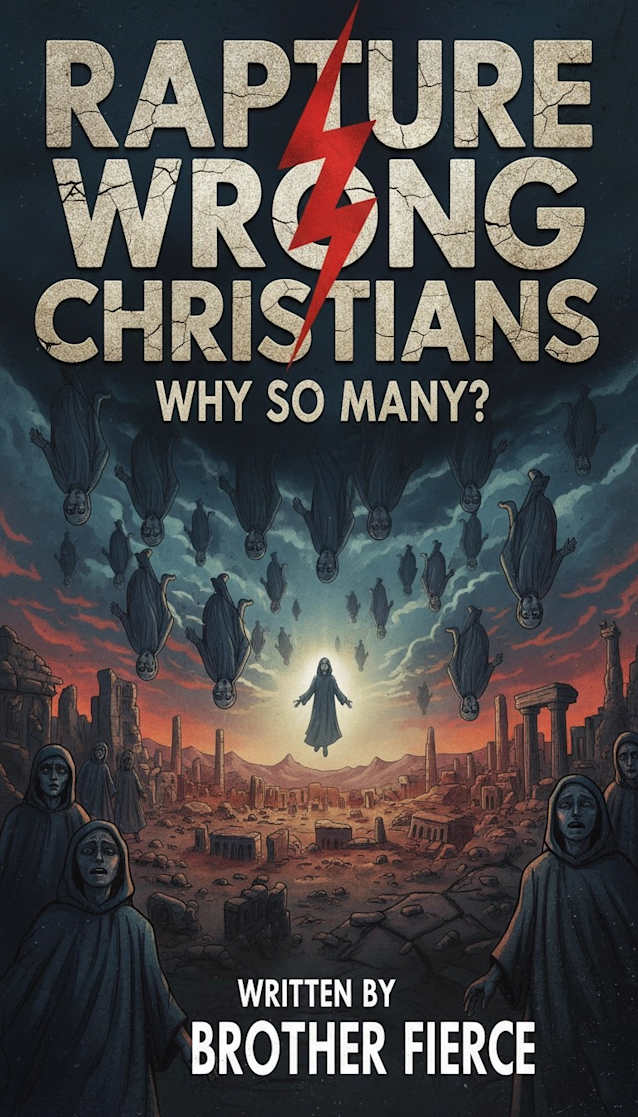
Rapture Wrong Christians. Why So Many?
About
To the discerning mind, the questioning heart, and the faithful seeker of truth within the Christian community. May this work serve as a beacon, illuminating the path toward a more biblically grounded and historically faithful understanding of God’s unfolding purposes. For those who have felt the disquiet of questioning popular doctrines, for those who yearn for an eschatology rooted firmly in the soil of Scripture and history, and for all who are committed to honoring the King James Version as a steadfast anchor in the turbulent seas of theological interpretation, this book is offered with profound respect and shared devotion. May it encourage a courageous re-examination of treasured beliefs, leading not to doubt, but to a deeper, more robust faith in the enduring Word of God. The Christian faith is built upon a bedrock of revealed truth, a narrative that spans from the creation of the world to its ultimate consummation. Central to this grand narrative are the prophecies concerning the end times, the return of our Lord Jesus Christ, and the establishment of His eternal kingdom. For generations, a particular interpretation of these prophecies, commonly known as the Rapture doctrine, has wrongly permeated the consciousness of many within the Church. This doctrine, with its dramatic portrayal of believers being secretly removed from the earth before a period of intense tribulation, has become deeply ingrained in popular Christian culture. Yet, as with any deeply held belief, a faithful examination demands that we continually return to the ultimate source of authority: the Holy Scriptures, as preserved in the King James Version. This book embarks on such an examination, not to sow discord, but to foster clarity and theological integrity. It is born from a conviction that a rigorous, historically informed, and textually precise approach to eschatology is not only beneficial but essential for the health and maturity of the Body of Christ. Let us delve into the historical silence surrounding this doctrine, trace its relatively recent emergence, and meticulously re-examine the biblical passages upon which it is most often predicated. Our journey will be one of careful exegesis, contextual understanding, and a humble pursuit of the truth as revealed in God’s infallible Word to expand Gods Kingdom. The landscape of Christian eschatology is vast and complex, marked by a rich tapestry of interpretations woven through centuries of theological discourse. Within this landscape, the doctrine of the Rapture has, in recent times, ascended to a position of significant prominence, shaping the expectations and beliefs of millions. It paints a vivid picture: a future event where the faithful are caught away from the earth in a sudden, silent, and instantaneous removal, preceding a period of unparalleled tribulation, Yet this is not found in the Bible. ANYWHERE. This vivid imagery, amplified by popular media and widely circulated literature, has become a cornerstone of end-times belief for a considerable segment of the Christian populace. However, as faithful stewards of God’s Word, we are called to a higher standard than mere acceptance of popular narratives. We must, with intellectual honesty and spiritual discernment, scrutinize every doctrine against the clear light of Scripture, particularly as it is faithfully rendered in the King James Version. This book is undertaken with that very purpose: to critically examine the biblical, historical, and theological underpinnings of the Rapture doctrine. It is written for those within the Christian community who find themselves questioning its biblical soundness, who have encountered alternative interpretations, or who simply desire a more deeply rooted, historically grounded understanding of biblical prophecy. We will begin by acknowledging the prevalent understanding of terms like ‘Rapture,’ ‘Tribulation,’ and ‘Second Coming,’ establishing a common ground before embarking on a thorough deconstruction and re-evaluation. Our methodological commitment will be to the King James Version, recognizing its unique place in the history of biblical translation and its enduring influence. This study is not an exercise in theological skepticism, but rather a disciplined effort to ensure that our understanding of God’s prophetic Word is not built upon shifting sands of human speculation or tradition, but upon the immovable rock of Holy Scripture, interpreted with wisdom and humility. The ‘last days,’ as commonly understood, will be re-examined, and we shall issue a clear call for scrutiny, encouraging a brave reassessment of long-held presuppositions in the pursuit of biblical truth.
Praise for this book
I got lost in the Scofield garbage Bible and so glad I read this book. It made me free.