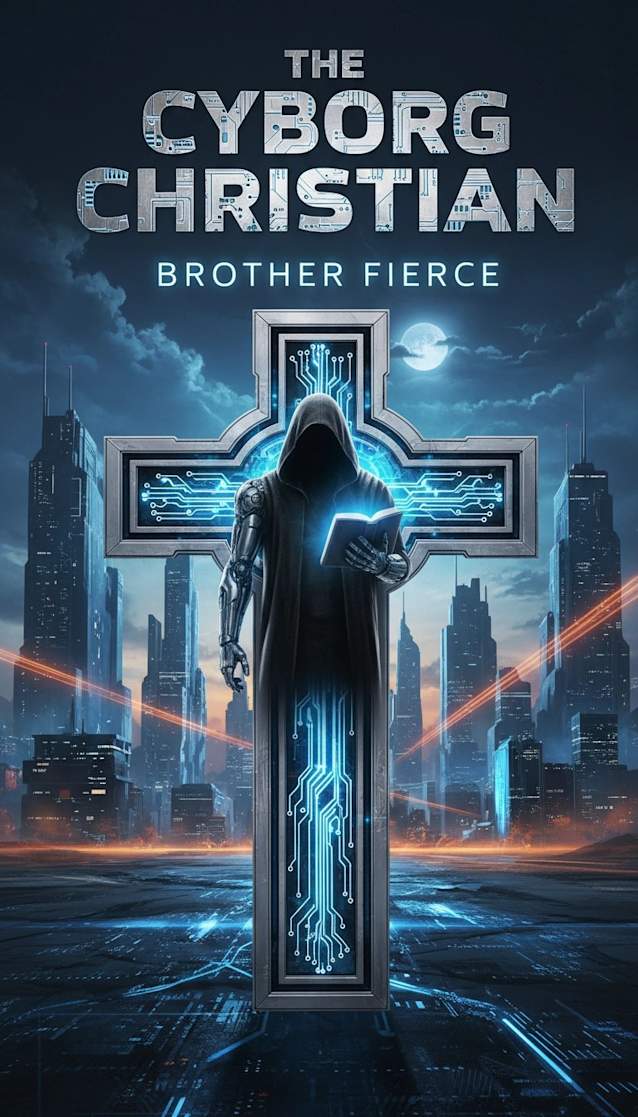
The Cyborg Christian
About
In this present age, we stand at a precipice, gazing into a future shaped by the accelerating currents of technological innovation. From the intricate dance of genetic code to the nascent sentience of artificial intelligence, humanity is rapidly acquiring powers once reserved for the divine. These advancements, while promising unprecedented solutions to age-old problems, also cast long shadows, raising profound questions about our identity, our purpose, and our very place in God’s creation. This book embarks on a journey to navigate these complex waters, not from the vantage point of a detached observer, but through the lens of an unwavering faith, anchored in the timeless wisdom of the 1611 King James Bible. We will explore how the aspirations of transhumanism—the pursuit of radical human enhancement and longevity—resonate with ancient prophecies, particularly those concerning the end times. The biblical narratives, often perceived as distant allegories, begin to echo with startling clarity in our laboratories and digital networks. The temptation to “play God,” to redesign ourselves and our world according to our own limited designs, is a potent force that requires careful theological scrutiny. We will endeavor to unpack the spiritual implications of these endeavors, distinguishing between the genuine desire to alleviate suffering and the hubristic ambition to usurp divine prerogative. This exploration is not an exercise in alarmism, but a call to thoughtful discernment. It is an invitation to engage critically with the technological advancements that are rapidly reshaping our society, to evaluate them against the immutable standard of Scripture. The King James Bible, with its rich language and profound theological depth, offers an indispensable compass for navigating this uncharted territory. It provides the framework through which we can understand the allure of technological solutions, the potential for deception, and the ultimate hope that lies beyond the transient promises of human ingenuity. Our aim is to equip believers with the spiritual discernment necessary to live faithfully in this transformative era, holding fast to the truth that transcends all temporal change. The twenty-first century unfolds as a testament to humanity’s relentless pursuit of progress, a relentless drive to conquer the limitations of the flesh and transcend the boundaries of the natural world. We stand at a unique juncture in history, where the once-fantastical visions of science fiction are rapidly materializing into tangible realities. Artificial intelligence begins to mimic human cognition, genetic engineering offers the power to rewrite the very code of life, and neural interfaces promise a seamless integration of human consciousness with the digital realm. These are not merely abstract scientific curiosities; they are transformative forces that are fundamentally reshaping our understanding of what it means to be human. Within this rapidly evolving landscape, the Christian theologian is called to a profound task: to interpret these developments through the prism of divine revelation, particularly through the lens of eschatology. The prophecies found within the sacred pages of the 1611 King James Bible, especially those concerning the latter days, speak of radical transformations, of a world facing unprecedented challenges, and of a spiritual battle for the very soul of humanity. It is our contention that many of these prophecies find uncanny resonance in the technological trajectories we are currently pursuing. This book endeavors to bridge the gap between the ancient wisdom of Scripture and the cutting edge of modern science and technology. We will explore the concept of the “Cyborg Christian,” not as a sensationalist notion, but as a starting point for theological reflection on human identity in an age of augmentation. We will contrast the Almighty’s perfect design for humanity, as articulated in Genesis, with mankind’s ambitious drive to “improve” upon it through genetic manipulation and technological integration. Furthermore, we will examine how science fiction, as a cultural precursor, has long envisioned scenarios that now appear to be prophetic foreshadowings of our present reality. Our guiding principle throughout this exploration will be the unwavering authority of the 1611 King James Bible. It is our immutable compass, providing the theological bedrock upon which we will build our arguments and interpretations. We will approach the intricate tapestry of transhumanism, artificial intelligence, genetic engineering, and cybernetics not with fear, but with sober discernment, seeking to understand their spiritual implications and their alignment, or divergence, from God’s eternal plan. This is an invitation to engage deeply with the present moment, armed with the enduring truth of God’s Word, and to prepare ourselves for the unfolding of His divine purposes.
Praise for this book
Outstanding!!.